
vectorinterpolators#
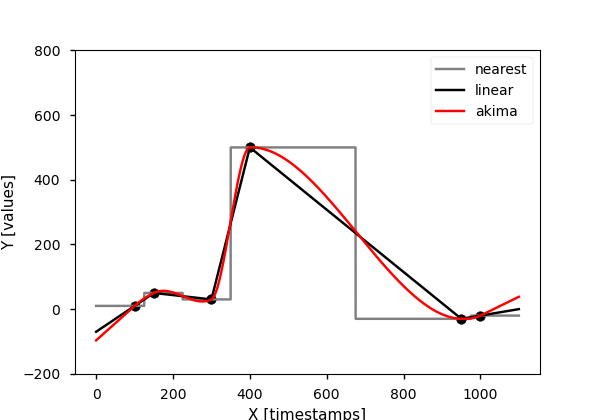
This modules provides interpolator objects to find interpolated values in lists. - x generally describes the index value lists - y descreibes the corresponding values
Example usage#

 # import this module
 import themachinethatgoesping.tools.vectorinterpolators as vip

 # create value lists
timestamps = [100, 150, 300, 400, 950, 1000]
values     = [10, 50, 30, 500, -30,-20]

# create interpolator object (here a linear interpolator)
linear = vip.LinearInterpolator(X=timestamps, Y=values)

# find interpolated y value for a given x value (e.g. a random timestamp)
y_value = lip(target_x=125)
print(y_value) #<< 30.0

# find extrapolated y value for value outside timestamps boundary
y_value = linear(target_x=50)
print(y_value) #<< -30.0
Types#
Class: AkimaInterpolator#
- class AkimaInterpolator(*args, **kwargs)#
Interpolator class to perform a (modified) akima interpolation. Uses boost makima interpolator. Note: this interpolator acts as linear interpolator if less than 4 values are stored.
- Template Args:
XYType:: type of the x and y values (must be floating point))
- __init__(self, X: Sequence[float] = [], Y: Sequence[float] = [], extrapolation_mode: themachinethatgoesping.tools_nanopy.vectorinterpolators.o_extr_mode = t_extr_mode.extrapolate) None#
Construct a new Interpolator object from a vector of pairs usage: interpolated_y_value = interpolator.interpolate(x_value)
- Parameters:
X – X vector; must be unique and sorted in ascending order. same size as Y!
Y – Y vector; must be unique and sorted in ascending order. same size as X!
extrapolation_mode – :option o_extr_mode <themachinethatgoesping.to ols.vectorinterpolators.t_extr_mode>` object that describes the extrapolation mode
- __call__(self, target_x: float) float#
- __call__(self, targets_x: numpy.ndarray[dtype=float64, shape=(*), order='C'], mp_cores: int = 1) numpy.ndarray[dtype=float64, order='C']
Overloaded function.
__call__(self, target_x: float) -> float
get the interpolated y value for given x target
- Parameters:
target_x – find the corresponding y value for this x value
- Returns:
corresponding y value
__call__(self, targets_x: numpy.ndarray[dtype=float64, shape=(*), order='C'], mp_cores: int = 1) -> numpy.ndarray[dtype=float64, order='C']
get interpolated y values for given x targets (vectorized call)
- Parameters:
targets_x – vector of x values. For each of these values find the corresponding y value
mp_cores – Number of OpenMP threads to use for parallelization. Default is 1 (no parallelism). Set to higher values to enable parallel interpolation.
- Returns:
std::vector<YType> corresponding y values
- append(self, x: float, y: float) None#
append an x- and the corresponding y value to the interpolator data. Exception: raises domain error, strong exception guarantee
- Parameters:
x – value, must be > than all existing x values
y – corresponding y value
- copy(self) AkimaInterpolator#
return a copy using the c++ default copy constructor
- extend(self, X: Sequence[float], Y: Sequence[float]) None#
append x and y value lists to the interpolator data (vectorized call) Exception: raises domain error, strong exception guarantee
- Parameters:
X – list of x values. Must be sorted in ascending order. All x values must be larger than the largest x value in the interpolator data.
Y – list of corresponding Y values. Must be same size as X
- from_binary = <nanobind.nb_func object>#
- get_data_X(self) list[float]#
return the x component of the internal data vector
- Returns:
std::vector<XType>
- get_data_Y(self) list[float]#
return the y component of the internal data vector
- Returns:
std::vector<YType>
- get_extrapolation_mode(self) themachinethatgoesping.tools_nanopy.vectorinterpolators.o_extr_mode#
Get the currently set extrapolation mode
- Returns:
o_extr_mode
- info_string(self, float_precision: int = 3, superscript_exponents: bool = True) str#
Return object information as string
- print(self, float_precision: int = 3, superscript_exponents: bool = True) None#
Print object information
- set_data_XY(self, X: Sequence[float], Y: Sequence[float]) None#
change the input data to these X and Y vectors
- Parameters:
X: – x vector (must be same size: order)
ascending (must be sorted in) – order)
Y: (y vector: must be same size) – y vector:
Class: LinearInterpolator#
- class LinearInterpolator(*args, **kwargs)#
Find linear interpolated values within vector data
- Template Args:
XType:: type of the x values (must be floating point) YType:: type of the y values (must be floating point)
- __init__(self, X: Sequence[float] = [], Y: Sequence[float] = [], extrapolation_mode: themachinethatgoesping.tools_nanopy.vectorinterpolators.o_extr_mode = t_extr_mode.extrapolate) None#
Construct a new Interpolator object from a vector of pairs usage: interpolated_y_value = interpolator.interpolate(x_value)
- Parameters:
X – X vector; must be unique and sorted in ascending order. same size as Y!
Y – Y vector; must be unique and sorted in ascending order. same size as X!
extrapolation_mode – :option o_extr_mode <themachinethatgoesping.to ols.vectorinterpolators.t_extr_mode>` object that describes the extrapolation mode
- __call__(self, target_x: float) float#
- __call__(self, targets_x: numpy.ndarray[dtype=float64, shape=(*), order='C'], mp_cores: int = 1) numpy.ndarray[dtype=float64, order='C']
Overloaded function.
__call__(self, target_x: float) -> float
get the interpolated y value for given x target
- Parameters:
target_x – find the corresponding y value for this x value
- Returns:
corresponding y value
__call__(self, targets_x: numpy.ndarray[dtype=float64, shape=(*), order='C'], mp_cores: int = 1) -> numpy.ndarray[dtype=float64, order='C']
get interpolated y values for given x targets (vectorized call)
- Parameters:
targets_x – vector of x values. For each of these values find the corresponding y value
mp_cores – Number of OpenMP threads to use for parallelization. Default is 1 (no parallelism). Set to higher values to enable parallel interpolation.
- Returns:
std::vector<YType> corresponding y values
- copy(self) LinearInterpolator#
return a copy using the c++ default copy constructor
- from_binary = <nanobind.nb_func object>#
- get_data_X(self) list[float]#
return the x component of the internal data vector
- Returns:
std::vector<XType>
- get_data_Y(self) list[float]#
return the y component of the internal data vector
- Returns:
std::vector<YType>
- get_extrapolation_mode(self) themachinethatgoesping.tools_nanopy.vectorinterpolators.o_extr_mode#
Get the currently set extrapolation mode
- Returns:
o_extr_mode
- info_string(self, float_precision: int = 3, superscript_exponents: bool = True) str#
Return object information as string
- print(self, float_precision: int = 3, superscript_exponents: bool = True) None#
Print object information
- set_data_XY(self, X: Sequence[float], Y: Sequence[float]) None#
change the input data to these X and Y vectors
- Parameters:
X: – x vector (must be same size: order)
ascending (must be sorted in) – order)
Y: (y vector: must be same size) – y vector:
Class: NearestInterpolator#
- class NearestInterpolator(*args, **kwargs)#
Interpolator class to find nearest neighbors within vector data
- Template Args:
XType:: type of the x values (must be floating point) YType:: type of the y values (must be floating point)
- __init__(self, X: Sequence[float] = [], Y: Sequence[float] = [], extrapolation_mode: themachinethatgoesping.tools_nanopy.vectorinterpolators.o_extr_mode = t_extr_mode.extrapolate) None#
Construct a new Interpolator object from a vector of pairs usage: interpolated_y_value = interpolator.interpolate(x_value)
- Parameters:
X – X vector; must be unique and sorted in ascending order. same size as Y!
Y – Y vector; must be unique and sorted in ascending order. same size as X!
extrapolation_mode – :option o_extr_mode <themachinethatgoesping.to ols.vectorinterpolators.t_extr_mode>` object that describes the extrapolation mode
- __call__(self, target_x: float) float#
- __call__(self, targets_x: numpy.ndarray[dtype=float64, shape=(*), order='C'], mp_cores: int = 1) numpy.ndarray[dtype=float64, order='C']
Overloaded function.
__call__(self, target_x: float) -> float
get the interpolated y value for given x target
- Parameters:
target_x – find the corresponding y value for this x value
- Returns:
corresponding y value
__call__(self, targets_x: numpy.ndarray[dtype=float64, shape=(*), order='C'], mp_cores: int = 1) -> numpy.ndarray[dtype=float64, order='C']
get interpolated y values for given x targets (vectorized call)
- Parameters:
targets_x – vector of x values. For each of these values find the corresponding y value
mp_cores – Number of OpenMP threads to use for parallelization. Default is 1 (no parallelism). Set to higher values to enable parallel interpolation.
- Returns:
std::vector<YType> corresponding y values
- copy(self) NearestInterpolator#
return a copy using the c++ default copy constructor
- from_binary = <nanobind.nb_func object>#
- get_data_X(self) list[float]#
return the x component of the internal data vector
- Returns:
std::vector<XType>
- get_data_Y(self) list[float]#
return the y component of the internal data vector
- Returns:
std::vector<YType>
- get_extrapolation_mode(self) themachinethatgoesping.tools_nanopy.vectorinterpolators.o_extr_mode#
Get the currently set extrapolation mode
- Returns:
o_extr_mode
- info_string(self, float_precision: int = 3, superscript_exponents: bool = True) str#
Return object information as string
- print(self, float_precision: int = 3, superscript_exponents: bool = True) None#
Print object information
- set_data_XY(self, X: Sequence[float], Y: Sequence[float]) None#
change the input data to these X and Y vectors
- Parameters:
X: – x vector (must be same size: order)
ascending (must be sorted in) – order)
Y: (y vector: must be same size) – y vector:
Class: SlerpInterpolator#
Example usage#
# import this module
import themachinethatgoesping.tools.vectorinterpolators as vip

# create value lists
timestamps = [100, 150, 1000] #x list, must be sorted, no duplicates
yaw       = [10, 50, -20]    #yaw values (degrees)
pitch     = [10, 50, -20]    #yaw values (degrees)
roll      = [10, 50, -20]    #yaw values (degrees)

# create interpolator object (here a linear interpolator)
slerp = vip.SlerpInterpolator(X=timestamps, Yaw=yaw, Pitch = pitch, Roll = roll)

# find interpolated y value for a given x value (e.g. a random timestamp)
ypr_value = slerp(target_x=125)
print(ypr_value) #<< [23.65708869335217, 32.74209962001251, 23.657088693352158]

# find extrapolated y value for value outside timestamps boundary
ypr_value = slerp(target_x=50)
print(ypr_value) #<< [355.97195450327666, -40.17949250447276, -4.0280454967233394]
Class#
- class SlerpInterpolator(*args, **kwargs)#
Class that implements a slerp interpolation for vectors. Data is internally represented in quaternions using lib eigen. Interfaces to represent the data in yaw, pitch, roll angles are provided. the __call__ equivalent to get interpolated yaw pitch roll is the ypr function
- Template Args:
XType:: type of the x values (must be floating point) YType:: floating point type of the y quaternion values (must be
floating point)
- __init__(self, X: Sequence[float] = [], Yaw: Sequence[float] = [], Pitch: Sequence[float] = [], Roll: Sequence[float] = [], input_in_degrees: bool = True, extrapolation_mode: t_extr_mode = t_extr_mode.extrapolate) None#
Construct a new Slerp Interpolator object using vectors of x, yaw, pitch and roll
- Parameters:
X – vector; must be unique and sorted in ascending order
yaw – vector with yaw data (rotation around z axis). Must be same size as X!
pitch – vector with pitch data (rotation around y axis). Must be same size as X!
roll – vector with roll data (rotation around x axis). Must be same size as X!
input_in_degrees – if true (default) yaw,pitch and roll are in °, otherwise [rad]
extrapolation_mode –
t_extr_modeobject that describes the extrapolation mode
- __call__(self, target_x: float, output_in_degrees: bool = True) list[float]#
- __call__(self, targets_x: Sequence[float], output_in_degrees: bool = True) list[list[float]]
Overloaded function.
__call__(self, target_x: float, output_in_degrees: bool = True) -> list[float]
get the interpolated yaw, pitch and roll values for given x target
- Parameters:
target_x – find the corresponding y value for this x value
output_in_degrees – if true, yaw pitch and roll input values are in ° otherwise rad
- Returns:
corresponding y value
__call__(self, targets_x: collections.abc.Sequence[float], output_in_degrees: bool = True) -> list[list[float]]
get the interpolated yaw, pitch and roll values for given x target (vectorized call)
- Parameters:
targets_x – vector of x values. For each of these values find the corrsponding yaw, pitch and roll value
output_in_degrees – if true, yaw pitch and roll input values are in ° otherwise rad
- Returns:
corresponding y value
- append(self, x: float, yaw: float, pitch: float, roll: float, input_in_degrees: bool = True) None#
- append(self, x: float, ypr: Sequence[float], input_in_degrees: bool = True) None
Overloaded function.
append(self, x: float, yaw: float, pitch: float, roll: float, input_in_degrees: bool = True) -> None
append an x, yaw, pitch, roll data point
- Parameters:
X – must be larger than all internal data points
yaw – rotation around z axis
pitch – rotation around y axis
roll – rotation around x axis
input_in_degrees – if true, yaw pitch and roll input values are in ° otherwise rad
append(self, x: float, ypr: collections.abc.Sequence[float], input_in_degrees: bool = True) -> None
append an x, yaw, pitch, roll data point
- Parameters:
X – must be larger than all internal data points
ypr – array with one yaw, pitch and roll data point
input_in_degrees – if true, yaw pitch and roll input values are in ° otherwise rad
- copy(self) SlerpInterpolator#
return a copy using the c++ default copy constructor
- extend(self, X: Sequence[float], Yaw: Sequence[float], Pitch: Sequence[float], Roll: Sequence[float], input_in_degrees: bool = True) None#
- extend(self, X: Sequence[float], YPR: Sequence[Sequence[float]], input_in_degrees: bool = True) None
Overloaded function.
extend(self, X: collections.abc.Sequence[float], Yaw: collections.abc.Sequence[float], Pitch: collections.abc.Sequence[float], Roll: collections.abc.Sequence[float], input_in_degrees: bool = True) -> None
append data with lists of x, yaw, pitch, roll data (vectorized call)
- Parameters:
X – vector; must be unique and sorted in ascending order
yaw – vector with yaw data (rotation around z axis). Must be same size as X!
pitch – vector with pitch data (rotation around y axis). Must be same size as X!
roll – vector with roll data (rotation around x axis). Must be same size as X!
input_in_degrees – if true, yaw pitch and roll input values are in ° otherwise rad
extend(self, X: collections.abc.Sequence[float], YPR: collections.abc.Sequence[collections.abc.Sequence[float]], input_in_degrees: bool = True) -> None
append data with list of x, yaw, pitch, roll data (vectorized call)
- Parameters:
X – vector; must be unique and sorted in ascending order
ypr – vector with yaw, pitch and roll data points. Must be same size as X!
input_in_degrees – if true, yaw pitch and roll input values are in ° otherwise rad
- from_binary = <nanobind.nb_func object>#
- get_data_X(self) list[float]#
return the x component of the internal data vector
- Returns:
std::vector<XType>
- get_data_YPR(self, output_in_degrees: bool = True) list[list[float]]#
return the internal yrp data vector
- Parameters:
output_in_degrees – convert yaw, pitch and roll to degrees (default = True)
- Returns:
std::vector<std::array<3, YType>> YPR
- get_extrapolation_mode(self) themachinethatgoesping.tools_nanopy.vectorinterpolators.o_extr_mode#
Get the currently set extrapolation mode
- Returns:
o_extr_mode
- info_string(self, float_precision: int = 3, superscript_exponents: bool = True) str#
Return object information as string
- print(self, float_precision: int = 3, superscript_exponents: bool = True) None#
Print object information
- set_data_XYPR(self, X: Sequence[float], Yaw: Sequence[float], Pitch: Sequence[float], Roll: Sequence[float], input_in_degrees: bool = True) None#
- set_data_XYPR(self, X: Sequence[float], YPR: Sequence[Sequence[float]], input_in_degrees: bool = True) None
change the input data to these X, yaw, pitch, roll vectors (will be converted to quaternion)
- Parameters:
X – vector; must be unique and sorted in ascending order
yaw – vector with yaw data (rotation around z axis). Must be same size as X!
pitch – vector with pitch data (rotation around y axis). Must be same size as X!
roll – vector with roll data (rotation around x axis). Must be same size as X!
input_in_degrees – if true, yaw pitch and roll input values are in ° otherwise rad